Showing posts with label Vedic Age. Show all posts

Sunday, December 27, 2015

The Religious form of Caste System


In Hinduism there exists four castes arranged in a hierarchy. Anyone who does not belong to one of these castes is an outcast. The religious word for caste is 'Varna'. Each Varna has certain duties and rights. Each Varna members have to work in certain occupation which only that Varna members are allowed. Each Varna has certain type of diet.

The highest Varna is of the Brahman. Members of this class are priests and the educated people of the society. The Varna after them in hierarchy is Kshatria.


The members of this class are the rulers and aristocrats of the society. After them are the Vaisia. Members of this class are the landlords and businessmen of the society. After them in hierarchy are the Sudra. Members of this class are the peasants and working class of the society who work in non-polluting jobs. The caste hierarchy ends here. Below these castes are the outcasts who are untouchable to the four castes. These untouchables worked in degrading jobs like cleaning, sewage etc.

The first three castes had social and economical rights which the Sudra and the untouchables did not have. The first three castes are also seen as 'twice born'. The intention in these two births is to the natural birth and to the ceremonial entrance to the society at a much later age.

Each Varna and also the untouchables are divided into many communities. These communities are called Jat or Jati (The caste is also used instead of Jat). For example the Brahmans have Jats called Gaur, Kokanastha, Sarasvat, Iyer and others. The outcasts have Jats like Mahar, Dhed, Mala, Madiga and others. The Sudra is the largest Varna and it has the largest number of communities. Each Jat is limited to professions worthy of their Varna. Each Jat is limited to the Varna diet. Each Jat members are allowed to marry only with their Jat members. People are born into their Jat and it cannot be changed.

This is the how the caste system is supposed to be in its religious form. But in reality it is much more complicated and different from its religious form.

The incarnations of Lord Vishnu


According to Hindu theology, three Gods rule the world. Brahma: the creator; Vishnu: the preserver and Shiva: the destroyer. Lord Vishnu does his job of preserving the world by incarnating himself in different forms at times of crisis.


In his first incarnation he appeared as a fish, Matsya, to convinced a human being, Manu, to collect all kinds of seeds and pairs of all birds and animals and to get with them on a boat. After this a flood drowned the earth and destroyed everything and the good hearted Manu started a new human race.

In his second incarnation as Kurma, the turtle, he helped the Gods and non-Gods to churn the ocean of milk, which held in its divine treasures.

In his third incarnation as Varaha, the boar, he used his tusks to raise the earth, which had sunk in the sea.

In his fourth incarnation he appeared as Narsimha, which was neither a man nor animal but a strange being, half-man and half-animal. He appeared in this form to kill a demon who was blessed that no animal or human could kill him.

In his fifth incarnation he was a dwarf, Vamana. As a little person he asked the demon, who ruled the three worlds, to give him land three times his foot. The demon agreed and Vamana turned into a huge giant and his feet covered the three worlds.

In his sixth incarnation he was a priest, Parsuram. Parsuram as a non-violent priest took an axe to kill warriors who threatened the human race.

In his seventh incarnation, he was Rama, the main character in the Ramayana, who killed the demon Ravan.

In his eighth incarnation he was Krishna who helped the right-minded Pandavas to defeat the villain Kauravas. Krishna is also the philosopher of the Bhagwad Gita, one of the holiest Hindu texts.

About the ninth incarnation. Two different personalities are identified as the ninth incarnation of Vishnu. One is Balaram, the elder brother of Krishna, who like Krishna helped the right-minded persons to defeat the villians.

The other personality identified as his ninth incarnation is Buddha, the establisher of Buddhism. Here too, there are two different beliefs for the purpose of this incarnation. According to one belief Vishnu incarnated as Buddha to preach non-violence and against animal sacrificing in religious ceremony. According to other belief, Vishnu incarnated as Buddha to start a new religion with a specific intention to convince some demons to give up worshipping Lord Shiva. For, Lord Shiva protected his worshippers and these demons used this protection to do whatever they wanted. Buddha convinced them with his new religion and they stopped worshipping Lord Shiva, which in turn allowed Shiva to punish them.

The tenth incarnation of Vishnu, Kalki, is suppose to arrive when the world will be at a brink of complete chaos. He will rise from the sea on a white horse and destroy all evil.

Vedic Period


The Vedic Period is one of major milestones in the history of India. It is estimated that the Vedic Period in India lasted from 1500 - 600 B.C. This period brought about a multitude of changes in the lifestyle of people. The Vedic age is broadly classified into two categories: Early Vedic Age and Later Vedic age. There was development in agricultural practices, worshipping patterns, philosophical outlooks, etc. A number of dynasties and new religions came into being during this period that left a huge impact on people. Read on the history of the Vedic Age.

The migration of the Aryans to the Indian sub continent is what triggered off the Vedic Age. As the name suggests, this period got its name from the four major Vedas or the sacred scriptures that were created during that time. The four sacred Vedas are Rig Veda, Sama Veda, Yajur Veda and Atharva Veda. These scriptures provide essential knowledge of the lifestyle during the Vedic Age. The Vedas are the foundation of the Hindu religion. Apart from the Vedas, we have two great epics, Ramayana and Mahabharata written during this age. These two epics tell a lot about the culture, society, religious beliefs, etc. of people during that time.

Vedic Religion
The Vedic period religions laid the foundation of the religious practices that are continued till date in modern India. These religions arose from the sacred scriptures that were composed during the Vedic period. These scriptures founded the very base of Hinduism in India. The scriptures that talk of the various religious practices are basically the four Vedas namely Rig Veda, Yajur Veda, Sama Veda and Atharva Veda.

Vedic Culture
The Vedic period has been broadly classified into two categories: the Early and Later Vedic Periods. This has been done according to the way the transition in the style of culture and society took place. The Vedic period society developed rapidly as time passed by. In Vedic age, culture and society developed from the crude form to the refined form as more and more people came to settle and started to contribute their own ideas to reform the society.

Religions in India

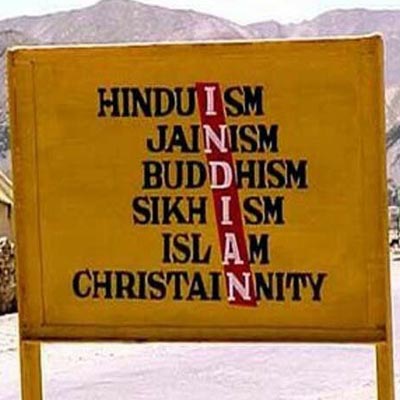
Religion in India is characterized by a diversity of religious beliefs and practices. The Indian subcontinent is the birthplace of some of the world's major religions; namely Islam, Hinduism, Buddhism, Jainism and Sikhism.


India known as the land of spirituality and philosophy, was the birthplace of some religions, which even exist today in the world.

The most dominant religion in India today is Hinduism. About 80% of Indians are Hindus. Hinduism is a colorful religion with a vast gallery of Gods and Goddesses. Hinduism is one of the ancient religions in the world. It is supposed to have developed about 5000 years ago. Later on in ancient period other religions developed in India.

Around 500 BC two other religions developed in India, namely, Buddhism and Jainism. Today only about 0.5% of Indians are Jains and about 0.7% are Buddhist. In ancient times Jainism and specially Buddhism were very popular in India. Indians who accepted Buddhist philosophy spread it not only within the Indian sub-continent but also to kingdoms east and south of India.

These three ancient religions, Hinduism, Buddhism and Jainism, are seen as the molders of the India philosophy. In 'modern' period new religions were also established in India.

One comparatively new religion in India is Sikhism and it was established in the 15th century. About 2% of Indians are Sikhs. There were other attempts to create new religions in India but they did not always succeed. For example, a Moghul emperor, Akbar, who reigned between 1556 - 1605, tried to establish a new religion, Din- E- Elahi, but it did not survive. There are other religious philosophies whose believers see themselves as a separate religion, but they do not always get this recognition. For example Lingayat of south India see themselves as a different religion, while others see them as a sect of Hinduism. There are also some tribal communities who demand to be recognized as separate religion from Hinduism. In the 19th century some Hindu reformers tried to remodel Hinduism to adjust it to modern period.

Along with the religions that developed in India, there are followers of non- Indian religions. The largest non-Indian religion is Islam. They are about 12% of India's population. Christians are more then 2% of India's population. There are also Zoroastrians who even though make less then 0.01% of India's population, are known around India. There are also a few thousand Jews in India. Judaism and Christianity might have arrived in India before they arrived in Europe.

HINDUISM - about 82%

ISLAM - about 12%

CHRISTIANITY - about 2.5%

SIKHISM - about 2%

BUDDHISM - about 0.7%

JAINISM - about 0.5%

ZOROASTRIANISM - about 0.01%

JUDAISM - about 0.0005%

Great monuments and Forts

Of all the Indian monuments, forts and palaces are most fascinating. Most of the Indian forts were built as a defense mechanism to keep the enemy away. The state of Rajasthan is home to numerous forts and palaces. Karnataka and Madhya Pradesh are also not far behind. In fact, whole India is dotted with forts of varied sizes. The magnificent forts and palaces of Rajasthan were built during the medieval period. The notable feature about each of the forts and palaces is the exquisite carving work that has survived till date and still receives appreciation from people worldwide.


These magnificent forts can not be described in words as they will look too small in front of splendor of forts that beautify India. Some prominent forts of Rajasthan are Amber fort, Chittorgarh fort, Jaisalmer fort, Lohagarh fort, Bikaner fort and Jaigarh fort. Delhi, the capital of India also boasts of some great forts. Some of the notable forts of Delhi are the Red fort, Purana Quila and the Tughlaqabad fort. These grand forts clearly depict the glory of Indian majestic past. There are many other forts of importance in India. Some of the most notable are the Red fort, Agra, the Gwalior fort and the Junagarh fort.

Agra Fort
The majestic Agra fort was built by the great Mughal emperor, Akbar in 1565-75. The Agra fort contains numerous impressive structures like the Jahangir Mahal, Khas Mahal, Diwan-i-Khass, Diwan-i-Am, Machchhi Bhawan and Moti Masjid. The Agra fort is enclosed by a double battlemented massive wall of red sandstone.


Amber Fort
The Amber fort is set in a picturesque location a little away from Jaipur, the capital of Rajasthan state. The Amber Fort presents a fascinating blend of Hindu and Muslim architecture. Raja Man Singh built the Amber fort in the sixteenth century (the construction of the Amber Fort was started in 1592).


Chittorgarh Fort
In the pages of history Chittorgarh holds a proud place and regarded as the symbol of Rajput chivalry, resistance and bravery. The Chittorgarh fort is situated 175 km to the east of Udaipur and is named after Chitrangad Maurya. Chittorgarh covers an area seven mile covering 700 acres of land with its fortifications, palaces, temples and towers.

Delhi Fort
The Red fort (Lal Qila) at Delhi was built by Shah Jahan on the banks of river Yamuna. The Red fort at Delhi is one of the massive forts in India and is a witness to the heyday of the Mughal Empire. Shah Jahan built the Red fort as the citadel of Shahjahanabad, his new capital at Delhi.

Gwalior Fort
The Gwalior fort spreads out over an area of 3 square km, surrounded by concrete walls of sandstone. The Gwalior fort encloses three temples, six palaces and numerous water tanks. At a point of time Gwalior fort was regarded as North and Central India's most invincible fortress.

Jaigarh Fort
The magnificent Jaigarh fort is located near Jaipur. Jaigarh fort or the fort of victory was constructed by Sawai Jai Singh of Jaipur in 1726. The Fort stands in the middle of thorn and scrub hills, which impart it a stout look. The Jaigarh fort gives an amazing view of the city below.

Jaisalmer Fort
One of the oldest and massive forts of Rajasthan, Jaisalmer fort is located in the remote Thar Desert. In the medieval times, the location of Jaisalmer on the trade route made it a prosperous town. Jaisalmer came to be celebrated for the chivalry and bravery of its rulers and also for the aesthetic sense represented by its palaces and Havelis.

Junagarh Fort
Located in Bikaner, the Junagarh fort is one of the most impressive fort complexes in India. Junagarh fort was built by Raja Rai Singh in 1588 AD. Junagarh fort is one of those few forts that are not built on a hilltop. The fort complex consists of palaces, courtyards, pavilions and balconies.

Lohagarh Fort
Lohagarh fort or the Iron fort was built in the early 18th century by the Jat ruler, Maharaja Suraj Mal. The Lohagarh fort is a living testimony to the chivalry and bravery of the Jat rulers of Bharatpur. Due to its impregnable defenses the fort came to be known by name of Lohagarh.

Purana Quila
The Purana Quila or the old fort was constructed by Humayun and Sher Shah. The old fort complex covers an area of about a mile. The walls of Purana Quila have three gates (the Humayun Darwaza, Talaqi Darwaza and Bara Darwaza) and are surrounded by a moat, which was fed by river Yamuna.

Tughlaqabad Fort
In a state of total ruin, the Tughlaqabad fort was once a symbolic of the might of the Tughlaq dynasty. The Tughlaqabad fort was built by Ghiyas-ud-din Tughlaq, the founder of the Tughlaq dynasty. The fort is spread over an extensive area and a piece of architectural marvel.

Golconda Fort
A majestic fortress on the outskirts of Hyderabad, Golconda Fort is one of the grandest forts of India. Built around 12th and 16th Century by various Qutub Shahi rulers, this fort has a rich history that is almost 400 years old. It is definitely a place worth visiting in case you are traveling to the south of India.

Srirangapatna Fort
One of the prime attractions in Mysore, Karnataka is the famous Srirangapatnam fort. Built in the year 1537 by a feudal lord, this magnificent fort is considered to be the second toughest fort of India. The Srirangapatna Fort has four main entrances known by the names of Delhi, Bangalore, Mysore and Water and Elephant gates.

Friday, December 25, 2015

Sculptures

The Gupta Period

Buddhist art flourished during this period, which has often been described as a golden age. A famous rock-cut monastery at Ajanta consists of several chaitya halls and numerous residential viharas. Both facades and interiors contain elegant relief sculpture, while interiors are covered with painted murals that feature superb figures drawn with a gracefully sinuous line. As in all periods, there is little difference in the images of the major Indian religions, Buddhist, Hindu, and Jain. Large stone figures, stone and terra-cotta reliefs, and large and small bronzes are made in the refined Gupta style; the level of production is uniformly high. After the 7th cent., although the rulers of the Pala and Sena dynasties (730–1197) were Hindu, significant Buddhist art was created. Images in bronze and in hard black stone from Nalanda and elsewhere reveal a development of the Gupta manner, with extensive attention to ornamental details.


Indo Islamic Architecture
The medieval period saw great developments in the field of architecture. With the coming of Muslims to India, many new features came to be introduced in buildings. The development of Muslim Style of Architecture of this period can be called the Indo-Islamic Architecture or the Indian Architecture influenced by Islamic Art. The Indo-Islamic style was neither strictly Islamic nor strictly Hindu.

Ancient Architecture
Indian architecture is as old as the history of the civilization. The earliest remains of recognizable building activity in the India dates back to the Indus Valley cities. Among India's ancient architectural remains, the most characteristic are the temples, Chaityas, Viharas, Stupas and other religious structures.

Cave Architecture
The cave architecture in India is believed to have begun in the third century BC. These caves were used by Buddhist and Jain monks as places of worship and residence. I


nitially the caves were excavated in the western India. Some examples of this type of cave structure are Chaityas and Viharas of Buddhists.

Rock Cut
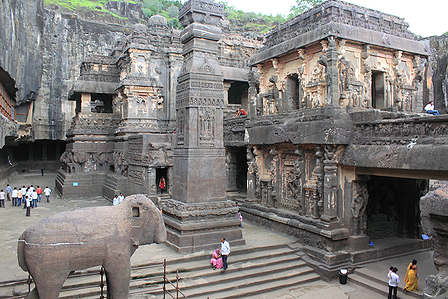
The Rock-cut structures present the most spectacular piece of ancient Indian art specimen. Most of the rock-cut structures were related to various religious communities. In the beginning, remarkable Buddhist and Jain monuments were produced in areas such as Bihar in the east and Maharashtra in the west.

Temple Architecture
In ancient India, temple architecture of high standard developed in almost all regions. The distinct architectural style of temple construction in different parts was a result of geographical, climatic, ethnic, racial, historical and linguistic diversities. Ancient Indian temples are classified in three broad types. This classification is based on different architectural styles, employed in the construction of the temples.

Architecture and Sculpture of the Hindu Dynasties


From the 6th cent. on, with the resurgence of Hindu dynasties throughout India, a characteristic temple plan was developed. An entrance portico led to a pillared hall (mandapa) into the cella. The shrine was often crowned by a large tower known as the shikhara. In S India the Dravida tower rose in a series of terraces, each symbolizing a different divinity; in the north, nagara spires ascended in a massive conical shape.

Innumerable temples were built that were so exuberantly embellished with sculpture that their style is called "sculptural architecture." The Khajuraho temples in central India (c.1000) represent one of the high points of the nagara buildings, and the damaged Temple of the Sun at Konarak (c.1250) reveals, in its famous erotic sculptures, carvings that combine balanced mass with delicate execution. The Jain temples at Mt. Abu, constructed entirely of imported white marble and dating from the 10th and 13th cent., have plain exteriors but are ornately carved inside.

In S India the 7th-century Pallava dynasty introduced the dravida style temple in a number of pyramidal raths (temples) at Mahabalipuram; an enormous cliff-face at the site is carved with a life-size representation of gods, men, and beasts, including the elephant family. The dravida style plan was used also in the 8th cent. in the quarried temple at Ellora. The Chola dynasty of S India further developed this form in the 11th cent., when they probably also cast most of large numbers of S Indian bronzes, of which the Nataraja (dancing Shiva) images are perhaps the best known.


The dravida style culminated in a series of expanded "temple townships," of which the largest is Srirangam, consisting of seven concentric enclosures. These ended in the comparatively crude stucco sculptured architecture of 17th-century Mandura. Medieval bronze sculpture was highly developed in S India. The chief subjects were the deities, figures of whom were used for processional and home ritual. Skilled cire-perdue sculptures were produced until the late 19th cent. in many regions of India.

Indian Painting

Adverse climate and other conditions have injured what wall painting existed. The most famous surviving Buddhist paintings are from the caves at Ajanta. Little is known of Hindu wall painting except for fragments at Ellora and Tanjore (see Thanjavur). The earliest Indian manuscript paintings are Buddhist, of the Pala dynasty; they have a delicate color. The 13th- to 15th-century Jain manuscript illuminations, painted in vivid red, blue, and gold, are most easily recognized by the characteristic protruding farther eye. Rajput miniature painting, which was practiced in N India from the 16th through the 19th cent., is related both to Mughal painting and to earlier Indian styles. It illustrates a variety of Hindu subjects: the ragamala series (musical modes), the legendary epics and romances, and particularly Krishna's deeds. Rajput painting is characterized by lyrical landscapes, sinuous grace in the depiction of the human form, and an interest in perspective.

The Modern Era

Little of the glorious tradition of Indian artistic achievement survived British rule. Indian artists adapted Western techniques and produced gouache paintings to suit the tastes of European buyers. Patua scrolls, containing swiftly executed watercolor illustrations of many subjects, became one source for the revival of Indian themes during the 20th cent. A growing nationalist sentiment pervaded Indian art in the early decades of the 20th cent. along with the conscious assimilation of Western styles. Major modern artists include Abanindranath Tagore, Nandalal Bose, Jamini Roy, Amrita Sher Gil, N. S. Bendre, M. B. Samant, Francis Souza, Bhagwan Kapoor, M. F. Husain, Bhupen Khakhar, Ram Kinker, Dhanraj Bhagat, Amar Nath Seghal, Chintamoni Kar, and Amina Ahmad.


Like all other aspects, colonization of Indian also had an impact on architecture style. With colonization, a new chapter in Indian architecture began. The Dutch, Portuguese and the French made their presence felt through their buildings but it was the English who had a lasting impact on architecture.

Indian Architecture


Indian Architecture

One of the most enduring achievements of Indian civilization is undoubtedly its architecture. Indian architecture, which has evolved through centuries, is the result of socio-economic and geographical conditions. Different types of Indian architectural styles include a mass of expressions over space and time, transformed by the forces of history considered unique to India. As a result of vast diversities, a vast range of architectural specimens have evolved, retaining a certain amount of continuity across history.


Indian architecture is that vast tapestry of production of the Indian Subcontinent that encompasses a multitude of expressions over space and time, transformed by the forces of history considered unique to the sub-continent, sometimes destroying, but most of the time absorbing.


Indian architecture, belonging to different periods of history, bears the stamp of respective periods. Though the cities of Indus Valley provide substantial evidence of extensive town planning, the beginnings of Indian architecture can be traced back to the advent of Buddhism in India. It was in this period that a large number of magnificent buildings came up. Some of the highlights of Buddhist art and architecture are the Great Stupa at Sanchi and the rock-cut caves at Ajanta.

With the establishment of Hindu kingdoms in South India, the south Indian school of architecture began to flourish. The most notable achievements of the Pallava rulers were the rock-cut temples of Mahabalipuram and the temples of Kanchipuram. The Chola, Hoyasala and Vijayanagar rulers also did remarkable job in the field of architecture. The temples at Thanjavur, Belur and Halebid bear testimony to the architectural excellence of the South Indian rulers.

In north India, there developed a new a different style of architecture. This was called as the Nagara style architecture. In central India, the Chandela rulers built a magnificent temple complex at Khajuraho. With the coming of the Muslim rulers, there developed a new architectural style in India- the Indo-Islamic architecture. The Indo-Islamic style was neither strictly Islamic nor strictly Hindu. The architecture of the medieval period can be divided into two main categories. They are the Delhi or the Imperial Style and the Mughal Architecture.

It was followed by a new style of architecture that developed as a result of colonization of India. This style of architecture came to be called as Indo-Saracenic. The Indo-Saracenic architecture combined the features of Hindu, Islamic and western elements. The colonial architecture exhibited itself through institutional, civic and utilitarian buildings such as post offices, railway stations, rest houses and government buildings.


Indian art and architecture, works of art and architecture produced on the Indian subcontinent, which is now divided among India, Pakistan, and Bangladesh. In the Western world, notable collections of Indian art can be seen in the British Museum, in the Victoria and Albert Museum, and in the Museum of Fine Arts, Boston.

Introduction

Although a great deal of Indian secular art was produced, it was essentially made of perishable material and has not survived. What has survived in the medium of stone is religious art. In both Buddhist and Hindu art, symbolism in gesture, posture, and attribute contains many levels of meaning. In images of the Buddha, different hand positions (mudras) signify religious states, such as the Enlightenment (Nirvana), Meditation, and Preaching. In Hindu sculpture, deities (see Vishnu, Krishna, and Shiva) are frequently represented with many hands to indicate their power to perform multiple deeds at the same time, and the hands each carry their characteristic attributes. With the exception of Mughal art and architecture, which demands separate treatment, the major trends in Indian art–Hindu, Buddhist, and Jain–are discussed within this article.

Indus Valley Civilization

The earliest Indian art emerged from the valley of the Indus River during the second half of the 3d millennium BC The best-known sites are Harappa, destroyed in the 19th cent., and Mohenjo-Daro; these are among the earliest examples of civic planning. Houses, markets, storage facilities, offices, and public baths were arranged in a gridlike scheme. There was also a highly developed drainage system.

The Indus civilization produced many statuettes made of steatite and limestone. Some statuettes resemble the hieratic style of contemporary Mesopotamia, while others are done in the smooth, sinuous style that is the prototype of later Indian sculpture, in which the plastic modeling reveals the animating breath of life (prana). Also found in this region are square steatite seals adorned with a range of animals, including naturalistically rendered bulls; ceramic storage jars with simple, stylized designs; toys with wheels; and figurines, which may be mother goddesses. Bronze weapons, tools, and sculptures indicate a sophistication in craftsmanship rather than a major aesthetic development.

Post-Indus Civilization through the Maurya Dynasty

Of the period from the end of the Indus civilization (c.1500 BC) until Alexander the Great crossed (325 BC) the Indus, few traces remain. However, the principles of Indian architecture were developed in wooden buildings, long since disintegrated.

From the great Maurya dynasty the most famous remains are the edict pillars, erected throughout N India by the Emperor Asoka to proclaim his devotion to Buddhism. The monolithic, smooth columns are over 50 ft (15 m) high and are surmounted by lotus capitals and animal figures. Some of the pillar capitals reveal forms that suggest Persepolitan influences. Also dating from the reign of Asoka is the earliest stone ogival chaitya window, found on the portal of a small rock-cut sanctuary near Bodh Gaya. The chaitya halls were monastic sanctuaries hewn out of rock. As they evolved, from the 3d cent. BC through the 1st millennium AD, they became elaborate colonnaded halls, or walls embellished with painting or sculpture.

Sunga and Andhra Dynasties

The earliest extant stupas date from the Sunga dynasty (2d–1st cent. BC) and early Andhra dynasty (1st cent. BC). These relic mounds are surrounded by railings and gateways covered with carved ornament. One of the main stupas is at Bharhut, where the sculpture is archaic in character. Relief medallions of the Buddha's life or of the jatakas (tales of his previous lives) are shallow cut, with all the incidents of each story arranged within a single composition. The bodies of semidivine beings including yakshis (female tree spirits) are flattened against the pillar of which they form part; prana is still emphasized.

The important stupa at Sanchi shows a similar style. Important carvings on the gateways of another stupa at Sanchi date from the early Andhra period. The yakshis have acquired full, graceful forms, and high-relief compositions are frequently conceived in a continuous method of narration. The carved railing from Bodh Gaya, the place of the Buddha's enlightenment, and the earliest surviving wall paintings are also early Andhra; paintings in the rock-cut cave at Ajanta narrate the Buddha's birth as an elephant and the entire synopsis of historic life. In the far south, in the Deccan, the later Andhra dynasty continued to flourish into the 1st cent. AD Its greatest monument is the carving at the Great Stupa at Amaravati, c.AD 200. The complex but coherent composition, the chiaroscuro, and the liveliness of the crowded surfaces distinguish these bas-reliefs.

Gandhara and Mathura

Under the Kushans, conquerors from central Asia, two of India's most important styles were developed between the 2d and 5th cent. AD: Gandhara art and art of Mathura. Gandhara art, named after the region of Gandhara now in Pakistan, presents some of the earliest images of the Buddha. Earlier at Bharhut and Sanchi, the Buddha's presence was represented by symbols, such as the pipal tree, the wheel of life, footprints, and an empty throne. The Gandhara style was profoundly influenced by 2d-century Hellenistic art and was itself highly influential in central and eastern Asia. Ivories and imported glass and lacquerware attest to the cosmopolitan tastes and extensive trade that characterized the period. Stupas and monasteries were adorned with relief friezes, often carved in dark schist, showing figures in classical poses with flowing Hellenistic draperies.

Farther east and south, contemporary Mathura, also under Kushan rule, created a wholly Indian sculptural art. Reddish limestone was the usual medium. More sensuous, heavier Buddhas whose limbs are created according to canonical instructions, smile directly at their worshipers. Reliefs of the yakshis carved against railing pillars are more frankly sensual and erotic than those at Sanchi. Buddhist iconography was developed in Gandhara. Mathura, however, preserved and developed Indian forms for three centuries.

Vedic Age in INDIA

Duration: 1500 BC to 500 BC

The Vedic Period or the Vedic Age refers to that time period when the Vedic Sanskrit texts were composed in India. The society that emerged during that time is known as the Vedic Period, or the Vedic Age, Civilization.


The Vedic Civilization flourished between the 1500 BC and 500 BC on the Indo-Gangetic Plains of the Indian subcontinent. This civilization laid down the foundation of Hinduism as well as the associated Indian culture. The Vedic Age was followed by the golden age of Hinduism and classical Sanskrit literature, the Maurya Empire and the Middle Kingdoms of India.

The Vedic period (or Vedic age) (ca.1750–500 BCE) was the period in Indian history during which the Vedas, the oldest scriptures of Hinduism, were composed.  During the early part of the Vedic period, the Indo-Aryans settled into northern India, bringing with them their specific religious traditions.

The Rig Veda is hard to translate accurately, because it is the oldest Indo-Aryan text, composed in the archaic Vedic Sanskrit. There are no closely contemporary extant texts, which makes it difficult to interpret.


Early Vedic Age: The Vedic age began in India in about 1500 BC and extend upto 6000 BCE with the coming of the Aryans, who scattered on the plains of northern India. Max Muller believes it an anomaly to regard the race as Aryan because scientifically Aryan connotes nothing but language. The relationship between the race and language of these people with the classical languages of Europe was established by a Bavarian Franz Bopp in 1816.

Aryans developed Vedic culture based on Vedas. The meaning of the word Veda is "knowledge", the best of all knowledge in the eyes of Hindus. It is a collection of hymns, prayers, charms, litanies and sacrificial formulae. There are four Vedas, namely, Rig Veda, Sam Veda, Yajur Veda and Atharva Veda.


Vedic Civilisation
Origin of Indian Music - Samveda
Mention of Word 'Shudra' - Rigveda 10th Mandala
Gayatri Mantra - Rigveda
Mention of word 'Yajna' - Brahmana
Somaras (drink) - Rigveda (9th Mandala)
Varna - Rigveda
Four fold division of Society - Rigveda 10th Mandala
Mention of four Ashrams - Jabala Upanishada
War between Aryan & Dasas - Rigveda
Transmigration of Soul - Brahadaranyka Upanishada
Five divisions of India - Aiteraya Brahamana
Wife and Husband are complementary - Satapathabrahmana
Battle of Ten kings - Rigveda (7th Mandala)
Superiority of Brahmins - Aiteraya Brahmana
Rajanaya - Rigveda 10th Mandala
Marut as Agriculturist - Satpatha Brahmana
Satyameva Jayate - Mundaka upanishada
Pashupath Shiva - Atharveda
Vishnu - Satapatha Brahmana

Conversion between Yam & Nachiketa - Katha Upanishada

Vedic Texts
Linguistically, the texts belonging to the Hindu Vedic Civilisation can be classified into the following five chronological branches:

Rigvedic

The oldest text of the Vedic Period, Rig Veda has many elements that are common with the Indo-Iranian texts, both in language and in content. One cannot find such similarity in any other Vedic text. It is believed that the compilation of the Rig Veda had stretched over a number of centuries. However, there is a conflict as to the completion date of the Rig Veda. Some historians believe it to be 1500 BC, while the others believe it to be 3000 BC. This time period coincided with the Indus Valley Civilization.

Mantra Language

The period of the Mantra Language includes the time of the compilation of the mantra and prose language of the Atharvaveda (Paippalada and Shaunakiya), the Rigveda Khilani, the Samaveda Samhita and the mantras of the Yajurveda. Though derived from the Rig Veda, all these texts experienced wide scale changes, in terms of language as well as at the time of reinterpretation. This time period coincided with the early Iron Age in northwestern India and the Black and Red Ware culture.

Samhita Prose

The period of Samhita Prose represents the compilation and codification of a Vedic canon. The linguistic changes of this time include the complete loss of the injunctive, the subjunctive and the aorist. The commentary part of the Yajurveda belongs to the Samhita Prose period. During this time, the Painted Grey Ware culture was evident.


Brahmana Prose

This period signifies Brahmanas proper of the four Vedas, along with the oldest Upanishads.

Sutra Language

The last division of the Vedic Sanskrit can be traced upto 500 BC. During this time, a major portion of the Srauta Sutras, the Grihya Sutras and some Upanishads were composed.

Epic and Paninian Sanskrit (Post Vedic)

In the post-Vedic Period, the compilation of Mahabharata and Ramayana epics took place. The Classical Sanskrit described by Panini also emerged after the Vedic Age. The Vedanta and the Pali Prakrit dialect of Buddhist scripture belong to this period. During this time, the Northern Black Polished Ware culture started spreading over the northern parts of India.

The end of the Vedic Period Civilization in India was marked by significant changes in the field of linguistics, culture and politics. With the invasion of the Indus valley by Darius I, in the 6th century, outside influences started creeping in.

Early Vedic Period (Rigvedic Period)

The Rigvedic Period represents the time period when the Rig Veda was composed. The Rig Veda comprises of religious hymns, and allusions to various myths and stories. Some of the books even contain elements from the pre-Vedic, common Indo-Iranian society. Some similarities are also found with the Andronovo culture and the Mittanni kingdoms. Thus, it is difficult to define the exact beginning of the Rigvedic period. The prominent features of the Rigvedic period are given below:

Political Organization

The political units during the Rigvedic or the early Vedic period comprised of Grama (village), Vish and Jana. The biggest political unit was that of Jana, after which came Vish and then, Grama. The leader of a Grama was called Gramani, of a Vish was called Vishpati and that of Jana was known as Jyeshta. The rashtra (state) was governed by a Rajan (King) and he was known as Gopa (protector) and Samrat (supreme ruler). The king ruled with the consent and approval of the people. There were four councils, namely Sabha, Samiti, Vidhata and Gana, of which women were allowed to attend only two, Sabha and Vidhata. The duty of the king was to protect the tribe, in which he was assisted by the Purohita (chaplain) and the Senani (army chief).

Society and Economy

Numerous social changes took place during the early Vedic period. The concept of Varna, along with the rules of marriage, was made quite stiff. Social stratification took place, with the Brahmins and the Kshatriyas being considered higher than the Shudras and the Vaisyas. Cows and bulls were accorded religious significance. The importance of agriculture started growing. The families became patriarchal and people began praying for the birth of a son.

Vedic Religious Practices

Rishis, composers of the hymns of the Rig Veda, were considered to be divine. Sacrifices and chanting of verses started gaining significance as the principal mode of worship. The main deities were Indra, Agni (the sacrificial fire), and Soma. People also worshipped Mitra-Varuna, Surya (Sun), Vayu (wind), Usha (dawn), Prithvi (Earth) and Aditi (the mother of gods). Yoga and Vedanta became the basic elements of the religion.

Later Vedic Period

The later Vedic Period commenced with the emergence of agriculture as the principal economic activity. Along with that, a declining trend was experienced as far as the importance of cattle rearing was concerned. Land and its protection started gaining significance and as a result, several large kingdoms arose.

Political Organization

The rise of sixteen Mahajanapadas, along with the increasing powers of the King, comprise of the other characteristics of this period. Rituals like rajasuya, (royal consecration), vajapeya (chariot race) and ashvamedha (horse sacrifice) became widespread. At the same time, the say of the people in the administration diminished.

Society

As far as the society is concerned, the concept of Varna and the rules of marriage became much more rigid than before. The status of the Brahmanas and Kshatriyas increased greatly and social mobility was totally restricted. The proper pronunciation of verses became to be considered as essential for prosperity and success in war. Kshatriyas started amassing wealth and started utilizing the services of the Brahmins. The other castes were slowly degraded. Around 500 BC, the later Vedic Period started giving rise to the period of the Middle kingdoms of India.