The Gupta Period
 Buddhist art flourished during this period, which has often been described as a golden age. A famous rock-cut monastery at Ajanta consists of several chaitya halls and numerous residential viharas. Both facades and interiors contain elegant relief sculpture, while interiors are covered with painted murals that feature superb figures drawn with a gracefully sinuous line. As in all periods, there is little difference in the images of the major Indian religions, Buddhist, Hindu, and Jain. Large stone figures, stone and terra-cotta reliefs, and large and small bronzes are made in the refined Gupta style; the level of production is uniformly high. After the 7th cent., although the rulers of the Pala and Sena dynasties (730–1197) were Hindu, significant Buddhist art was created. Images in bronze and in hard black stone from Nalanda and elsewhere reveal a development of the Gupta manner, with extensive attention to ornamental details.
Indo Islamic Architecture
The medieval period saw great developments in the field of architecture. With the coming of Muslims to India, many new features came to be introduced in buildings. The development of Muslim Style of Architecture of this period can be called the Indo-Islamic Architecture or the Indian Architecture influenced by Islamic Art. The Indo-Islamic style was neither strictly Islamic nor strictly Hindu.
Ancient Architecture
Indian architecture is as old as the history of the civilization. The earliest remains of recognizable building activity in the India dates back to the Indus Valley cities. Among India's ancient architectural remains, the most characteristic are the temples, Chaityas, Viharas, Stupas and other religious structures.
Cave Architecture
The cave architecture in India is believed to have begun in the third century BC. These caves were used by Buddhist and Jain monks as places of worship and residence. I

nitially the caves were excavated in the western India. Some examples of this type of cave structure are Chaityas and Viharas of Buddhists.
Rock Cut
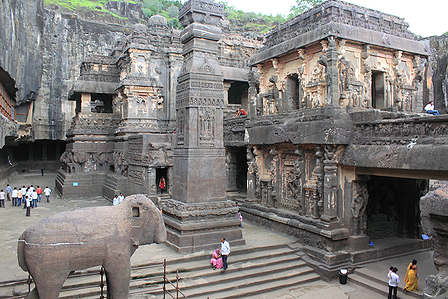
The Rock-cut structures present the most spectacular piece of ancient Indian art specimen. Most of the rock-cut structures were related to various religious communities. In the beginning, remarkable Buddhist and Jain monuments were produced in areas such as Bihar in the east and Maharashtra in the west.
 Temple Architecture
In ancient India, temple architecture of high standard developed in almost all regions. The distinct architectural style of temple construction in different parts was a result of geographical, climatic, ethnic, racial, historical and linguistic diversities. Ancient Indian temples are classified in three broad types. This classification is based on different architectural styles, employed in the construction of the temples.
 Buddhist art flourished during this period, which has often been described as a golden age. A famous rock-cut monastery at Ajanta consists of several chaitya halls and numerous residential viharas. Both facades and interiors contain elegant relief sculpture, while interiors are covered with painted murals that feature superb figures drawn with a gracefully sinuous line. As in all periods, there is little difference in the images of the major Indian religions, Buddhist, Hindu, and Jain. Large stone figures, stone and terra-cotta reliefs, and large and small bronzes are made in the refined Gupta style; the level of production is uniformly high. After the 7th cent., although the rulers of the Pala and Sena dynasties (730–1197) were Hindu, significant Buddhist art was created. Images in bronze and in hard black stone from Nalanda and elsewhere reveal a development of the Gupta manner, with extensive attention to ornamental details.
Indo Islamic Architecture
The medieval period saw great developments in the field of architecture. With the coming of Muslims to India, many new features came to be introduced in buildings. The development of Muslim Style of Architecture of this period can be called the Indo-Islamic Architecture or the Indian Architecture influenced by Islamic Art. The Indo-Islamic style was neither strictly Islamic nor strictly Hindu.
Ancient Architecture
Indian architecture is as old as the history of the civilization. The earliest remains of recognizable building activity in the India dates back to the Indus Valley cities. Among India's ancient architectural remains, the most characteristic are the temples, Chaityas, Viharas, Stupas and other religious structures.
Cave Architecture
The cave architecture in India is believed to have begun in the third century BC. These caves were used by Buddhist and Jain monks as places of worship and residence. I

nitially the caves were excavated in the western India. Some examples of this type of cave structure are Chaityas and Viharas of Buddhists.
Rock Cut
The Rock-cut structures present the most spectacular piece of ancient Indian art specimen. Most of the rock-cut structures were related to various religious communities. In the beginning, remarkable Buddhist and Jain monuments were produced in areas such as Bihar in the east and Maharashtra in the west.
 Temple Architecture
In ancient India, temple architecture of high standard developed in almost all regions. The distinct architectural style of temple construction in different parts was a result of geographical, climatic, ethnic, racial, historical and linguistic diversities. Ancient Indian temples are classified in three broad types. This classification is based on different architectural styles, employed in the construction of the temples.